The VMware Certified Design Expert (original VCDX) program has been retired and all original VCDX certifications expired in June 2026. Original VCDX has been replaced by the VMware Certified Distinguished Expert (revamped VCDX) program, which was announced in 2025. The rest of this article will use original VCDX and revamped VCDX to distinguish between the old and new.
The original VCDX program had four technology tracks: Data Center Virtualization (VMware vSphere), Cloud Management Automation (VMware vCloud Director and VMware vRealize/Aria Automation), Network Virtualization (VMware NSX), and Desktop/End User Computing (VMware Horizon and VMware Workspace ONE). The certification pre-requisites included technology specific VCP, VCIX (VCAP deploy exam via live lab administration), and a VCAP design exam before submitting an architectural design package to the VCDX program before being invited to a panel defense.
That all changed when Broadcom acquired VMware from Dell Technologies in November 2023 and proceeded to revamp the VMware organization and solution stack. VMware Horizon and VMware Workspace ONE were spun off to become Omnissa, and Broadcom doubled down on VMware Cloud Foundation (VCF) as being the way to consume the entire suite at scale. No more picking and choosing which solution and license components you wanted to use. The first exception was vSphere customers could consume vSphere and VCF Operations Manager with VMware vSphere Foundation (VVF). The second exception was the VMware Application Networking and Security (ANS) solution stack being an optional add-on to VCF.
These changes have been executed in VMware Cloud Foundation 9.0 (2025), VMware Cloud Foundation 9.1 (2026), with future versions of VCF coming each year. Major architectural changes in the VCF control plane have been made as Broadcom moves VCF to their desired target state. The first major change to mention is the move from license keys to license files with a dedicated License Manager running in VCF paired with the customer’s Broadcom Business Console tracking license usage. The second major change is the containerization of the control plane with the VCF Management Services Platform (VMSP/VSP) where services like VCF Fleet Manager and VCF Operations for Logs run as containers (no more OVA appliances). The third major change is the convergence of vCloud Director (vCD) and Aria Automation into VCF Automation.
The revamped VCDX program has changed from being technology-based to role-based, with the Architect, Administrator, and Support roles (see diagram below). To achieve the revamped VCDX, you have to complete the relevant role-based VCP and VCAP, and three technology domain VCAPs (VKS VCAP is mandatory) and then apply to the revamped VCDX program as a VCDX candidate.
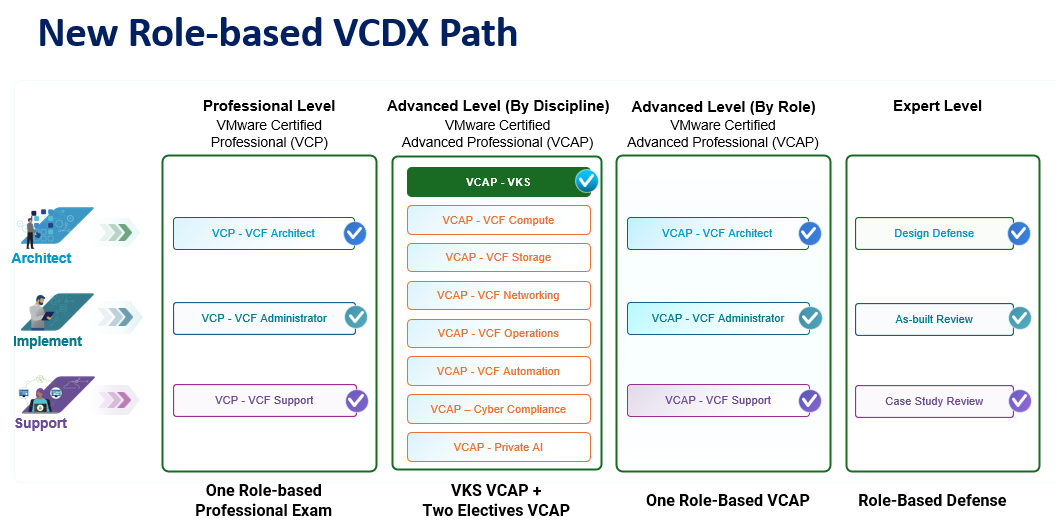
This diagram was sourced from NTPRO.NL. I have not seen it anywhere on the Broadcom site.
Has the revamped VCDX program fully launched?
I would say not yet. There were reports on LinkedIn of a revamped VCDX VCF Architect defense panel being held at VMware Explore 2026 last week. The revamped VCDX VCF Architect Credly badge has been published by Broadcom, but I have not seen it awarded to anyone yet (myself included). The revamped VCDX VCF Administrator and VCDX VCF Support badges do not exist yet. Original VCDX holders will be grandfathered into revamped VCDX when they complete the VCP and VCAP certification requirements; they will not need to defend before a panel again (see program overview PDF link in next section below).
The three role-based VCF VCP exams are available (Architect, Administrator, and Support). Five of the eight technology VCF VCAP exams (Network, Storage, VKS, Automation, and Operations) are available, and the three role-based VCF VCAP exams are available (Architect, Administrator, and Support). Pearson VUE also lists the revamped VCDX Architect Candidate exam (4V0-01.26) as available (not sure if this is another exam or a way to apply for the panel defense).
Where can I find out more about the revamped VCDX program?
Visit these Broadcom resources:
- Revamped VCDX 2025 Blog Post
- Revamped VCDX 2026 Blog Post
- VMware Cloud Foundation VCP and VCAP exams
- Revamped VCDX certification page (very light on information at time of writing)
- Revamped VCDX certification program overview (PDF)
- VMware Cloud Foundation Certification Paths (currently 2025 version)
Is the revamped VCDX at the same level of validation as the original VCDX?
Too soon to tell. The revamped VCDX role-based exam blueprints have not been published yet.
Update – from listening to a few podcasts with Broadcom explaining the revamped VCDX program:
- VCDX defense cost is $250.
- VCDX VCF Architect candidate submits a design package to be reviewed. If accepted, they can then defend VCDX VCF Architect with the panel.
- VCDX VCF Architect panel defense is 60 minutes with a design scenario only. You do not need to present your submitted design (this was an original VCDX requirement).
How can you tell if someone is an original VCDX?
The Broadcom academic transcript does not show expired certifications (see image below), so you will have to rely upon Credly badges from the original VCDX certified individual. The Credly badge with the original VCDX number will still list the technology tracks and is current (not expired).
Update – original VCDX entries now appear in the Broadcom academic transcript. It was apparently a processing error.
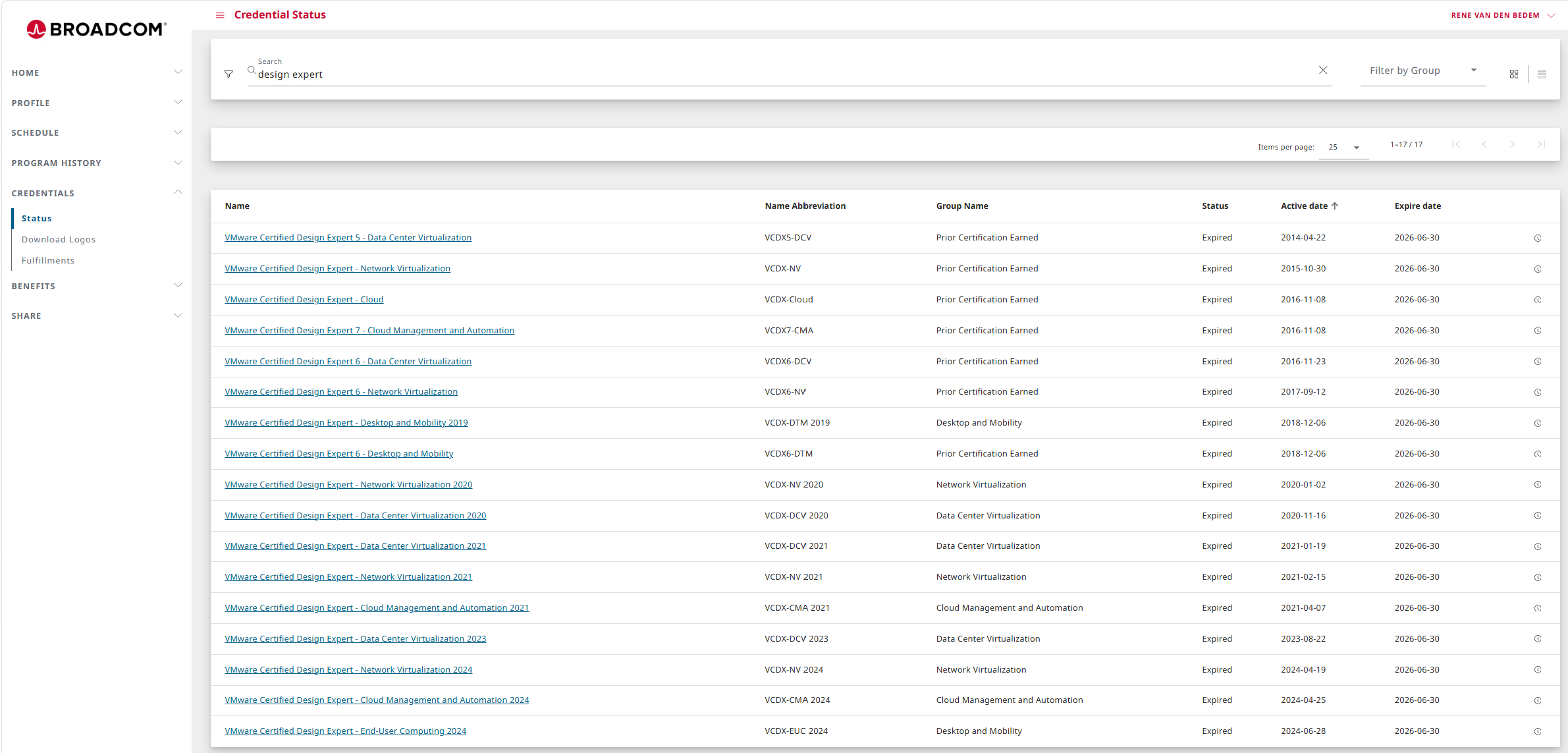
Some examples:
- VCDX#133 (DCV, CMA, NV, & DTM)
- VCDX-DCV 5
- VCDX-Cloud
- VCDX-NV
- VCDX-CMA 7
- VCDX-DCV 6
- VCDX-DTM 6
- VCDX-NV 6
- VCDX-DTM 2019
- VCDX-NV 2020
- VCDX-DCV 2020
- VCDX-DCV 2021
- VCDX-NV 2021
- VCDX-CMA 2021
- VCDX-DCV 2023
- VCDX-NV 2024
- VCDX-CMA 2024
- VCDX-EUC 2024
How to tell if someone is a revamped VCDX?
Their Broadcom academic transcript will list it and their Credly badge for the revamped VCDX role will be valid. No examples as yet.


